Search This Blog

Friday, 21 August 2015

My New Book

My new book, in French,  L'île de l'ouest is published on Amazon books at this link
Amazon France
You can also download a free ebook book version at this link
Smashwords
I hope readers will like it, even if it could be considered politically incorrect!
It is also available at Amazon UK at this link
Amazon UK 
and Amazon US at this link
Amazon USA 

Résumé ou avertissement!
 
Ce livre est une histoire écrite par John Ennis quelque part dans le futur, un futur peut-être plus proche que vous ne l'imaginez. En ce moment-même, il a peut-être onze ou douze ans et est lycéen à Dublin. Bientôt il va partir avec ses parents à Boston aux États-Unis. Mais, son histoire prend lieu dans ce monde futur, où les nations, les régimes politiques et les idées, sont très différents de ceux que vous connaissez aujourd'hui. 
Si, VOUS cherchez le politiquement correct, il faut que vous vous arrêtiez ici, remettiez ce livre où vous l'avez trouvé, cherchiez quelque chose d'autre à lire, quelque chose qui ne vous empêchera pas de dormir la nuit.
 Si, VOUS cherchez un exercice de style littéraire, vous ne le trouverez pas ici non plus, ni des tournures de phrases élégantes, ni la grammaire de vos grands-mères. 
Si, VOUS décidez d'entrer dans ce monde futur, vous allez découvrir l'étrange pays de l'al-Jazirat al-Gharb, La Nation de France, le maréchal d'Albignac, Hassan bin Ibrani, Henri Boublil, les Gallos, les non Gallos, les Néos, les zonards, les clapos, les horbans et les exclus.
N’oubliez pas, c'est VOUS qui avez la création du monde futur dans vos mains, un monde dans lequel vos enfants et petits-enfants vont vivre, où l'ordre politique sera certainement différent de celui que vous connaissez actuellement.

Tuesday, 14 July 2015

Looking for a holiday in Greece this summer?

 This Champagne Marxist will rent you his villa on a Greek island for just 5000 euros a week according to the London Daily Mail


Greece News Overload

In spite of being saturated with news on Greece I would like to add a comment to bring some realistic perspective to certain opinions voiced over the last few days. Opinions in my modest view extremist:
Slovakia's finance minister talked of Greeks reaping what they sowed in their "Greek spring". It was a comparison of facility. The Arab world had attempted to throw of the yoke of dictatorship and oppression, which was not the case in Greece, theirs was one of poor government and widespread corruption. There was no torture and death, the days of the "colonels" were long gone.
Certain commentators likened the Greek acceptance to EU demands as another Versailles, of course there was not twenty million dead, or great swaths of Europe devastated by war. It was a plain old fashioned bankruptcy arrangement where the debtor was put under the tutelage of the court.
It was a result of the refusal or the incapacity of a country to reform, policies of appeasing every demand for more; deferring tough decisions with a short-term solutions, namely burdening the country with more unsustainable debt, in the vague hope the problem would go away. Were the Greeks profligate? Yes, but no more than their fellow member countries in the EU including France, Italy and the UK, whose decision making process dodged the real issues and whose debt burdens were perhaps the greatest in history during peace time.
The vociferous British press led a sustained campaign against the Eurozone and the EU in general; to find a comparable outpouring of vitriol it would have been necessary to go back of English pamphleteers lampooned Napoleon, when his armies occupied large swaths of Europe and his puppets, including his own family members, were thrust onto the thrones of Europe including those of Italy, Holland, Spain and Westphalia.
Napoleon declared: "I wished to found a European system, a European Code of Laws, a European judiciary: there would be but one people in Europe." The ideas was noble but not the means. In 2015, Europe's talked wrangling through the night to find a compromise, as they had been doing for sixty years.
Had Europe come of age, could those fools who stood on the sidelines crying for disunion and strife, the little Englanders of UKIP, Podemos, the Front National, the PVV of Geert Wilders and others be held in check, if not the dogs of war and strife would be unleashed and the consequences terrible.

Friday, 10 July 2015

Contribution by James Denis Herring

In the decades to come Western society will be controlled by a handful 
of transnational corporations wielding more economic power and influence 
than many middle sized countries. The annual sales of Wal-Mart in 2014 
was $486 billion whilst that of Poland, ranked 23 in GDP by the World Bank, 
with a population of near forty million was $546 billion.
 
The development of these businesses based on a profit model escape political 
control. As a result their decisions and market domination will inevitably 
have a profound effect on democracy. 
  
In Great Britain there are at present :
5 big banks
5 major food retailers
5 main fuel distributers 
5 major automobile distributers
5 large civil engineering companies
5 main energy suppliers
4/5 Main road haulage groups
4 Major audit  partnerships
3/5 major restaurant chains
 
This is compounded by the advance of technology and the loss of manufacturing
jobs, this will acarcebated by the decline of the middle class professionals 
resulting in a more unequal society leading to instability and unrest with the 
risk of economic decline.
 
In the past I believed politicians and civil servants ran the country, making
strategic decisions and determining the future, that is not now the case: 
little by little power is being devolved to these transnational corporations 
where the combined sales of the top two hundred is now greater than the 
combined economies of all but the nine most economical powerful countries 
in the world.
 
Education has been promoted by politicians as a solution to this problem in 
Great Britain, where school/college leaving age has been extended by two 
years to eighteen, but with little visible success so far.

Thursday, 9 July 2015

Translation problems

Two of my books translated into French, by yours truely, have been severely criticised, no doubt with reason. Critics have pointed to my syntax and grammar, which are unfortunately based on my particular version of the language, one that I have used everyday for the last forty plus years. 
Was it a mistake to have translated my books, perhaps, but the result is a manifestation of the way I think and I cannot simply bin that. 
As Salvador Dali note: "Have no fear of perfection - you'll never reach it." 
That can seem like a weak excuse, though I have to admit it can be difficult to read works that do not conform to conventional rules.
Modern examples of nonconformist writers include Joyce and Elroy whose styles are unconventional and can be difficult to read. Further back in time are Mark Twain and Jonathan Swift, whose styles and syntax are of another era and quite derouting, this does not however prevent readers from understanding and appreciating their works.  
Is my French a sort of creole? Sure. Too bad.
Forgetting all that here's a picture I took in Paris a couple of weeks back of the Louis Vuitton Foundation designed by Frank Gehry.


Wednesday, 8 July 2015

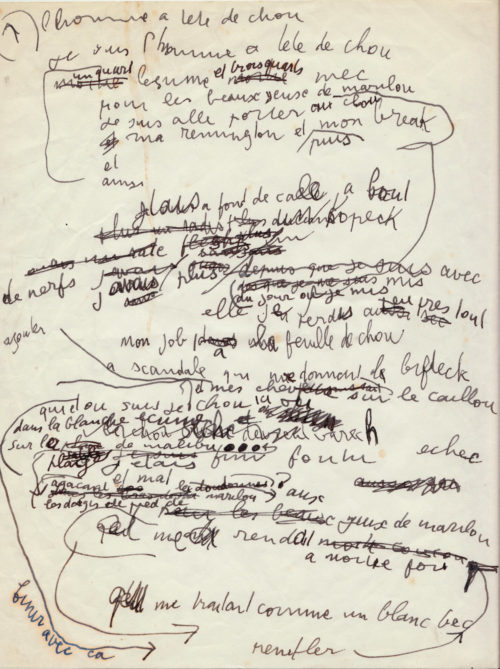
Manuscripts

People are often surprised when they discover writers' manuscripts. I myself was surprised when I first saw one of Jean Cocteau's in a Paris bookstore many years ago. Some time later I visited the Parisian Musée des Letrres et Manuscrits where there are some remarkable exemples of manuscripts.
More recently was an interview with Richard Ford, the American novelist, who stills writes his works with pen and paper, modifying, noting, inserting words and notes in a astonishingly ordered, but seemingly simplistic style.
Below is a page from Serge Gainsbourg's L'homme à tête de choux, of course those who are familiar with the late Gainsbourg will sgrug their shoulders; what did you expect?
GAINSBOURG

On the other hand you could expect something more elegant from Norman Mailer; no! here is the character timeline for 'Harlot's Ghost' - a fictional chronicle of the C.I.A. published in 1991.


Innovator: The late writer Norman Mailer's character timeline for 'Harlot's Ghost' - a fictional chronicle of the C.I.A. which was published in 1991

Themes

Several of my stories are set against a background of the financial world, notably the crisis that started with the subprime crash and the collapse of Leman Brothers. Today as we observe the world around us the news is dominated by the Greek crisis with the Middle East, terror and oil making regular appearances. Unnoticed are the problems facing China which have been accererbated in recent days by a precipitous stock market crash. As I write the Shanghai composite index closed with a loss of almost 6% on the trading day, bringing the losses since mid-June to over 30%. Significant by any standard.
This all adds fuel to the adventures of Michael Fitzwilliams, Pat Kennedy and Tom Barton protagonists in three of my recent books: Death of a Financier, The Turning Point and The Plan, whose adventures continue in the story I am currently writing: The Rise of the Rich.